Pages

Showing posts with label healthy living. Show all posts

Monday, February 1, 2016

the happy runner

Something many don't know about me is that I love to run.
Some of my family know this about me.
But I don't talk about it a lot, because I don't always have the time for it.
I've been running on and off now for the past 10 years because of various things.
I've had to start over many times from pregnancy, and recovering post-partum.
I also had to take a long break in 2011 because I broke my ankle.
It was a long recovery.
But I'm back at it and its been a real joy.

Can you believe I got to run outside yesterday....the last day of January???


The sun was out.
The breeze was cooling,
yet, the air was warm.
It was the perfect day for a run.
In JANUARY!!!!!


We live on a fast-pace road in the middle of the country.
Cars drive fast, but are few.
The scenery makes for a breath-taking run.
You not only feel good about your run....
you feel good about life.


Here is a gorgeous view of Lake Canandaigua.
Just snapped with my phone while running to one of my turn-around points.


Runs on these type of days remind me of how blessed I am.
I meditate on the goodness of God.
I melt in the refreshing blow of the wind on my face.
I fly to the beat of the music playing.
And I can't help but be happy.

I am the #happyrunner

Monday, November 11, 2013

Am I called to the earth?

I was recently "googling" whether Jell-O was gluten-free, when I had a storm of thoughts pertaining to "sub-duing and taken dominion over the earth" as believers. I know, not quite your typical thought process happening here, but I can explain. It really all started when I saw someone comment about Jello-O being made from the bones and cartilage of animal matter. The person pretty much said eating Jell-O was disgusting and now that we know better we should make better decisions about what part of the animal we are eating. I found this ignorant statement somewhat embarrassing, as the person continued to talk about the savaging in Native American (better as "First Nations" people) customs, who used every part of the animal for something. "We should know better now...." she said.
 
I do have a point in all this. I recently have been very intrigued by Native American beliefs and customs and have been fascinated with their love for life. I have also been deeply inspired by their respect for the earth and every living thing in it. I'm NOT saying I embrace all their practices and ways of worship (all first nations tribes can be vastly different from one another). But what I am saying, is I found that they have tapped into a way of life, that is a very instinctly way of living, that we have exited out of a society as a whole - especially in the church. Native American beliefs are deeply rooted in their culture. They believe EVERYTHING is sacred, from the largest mountain to the smallest plant and animal. A lesson can be found in all experiences and everything has a purpose. To sum up Native spirituality: it is about HONOR, LOVE, and RESPECT. Not only do they love, honor, and respect our Creator and our "Mother Earth", but also every living thing. It is about being in touch with ourselves and everything around us. It is about knowing and understanding that we are part of everything, and everything is a part of us, believing we are all One. In fact, the reason why a native man would use every part of the animal was not because he was a "savage" but because he lived in harmony with creation. He wanted the living thing to only die with [full] purpose. It doesn't make sense to a native American to waste anything, because it goes against his code of honor. If it has to die, then it must be utilized in every possible way. This became their way of survival. I feel as a culture as a whole we could learn a lot from this. I have personally seen a lot of people (even in the church) mock this "organic" was of living that is starting to trend now, as if it's a new thing. But guess what? Going green, or being "crunchy" or a little "granola", or even a bit "natural" isn't AT ALL a new thing - it's a divine thing, and he's put the instinct in us from the beginning.

My question to many believers who preach and teach on subduing the earth, taking dominion, establishing His Kingdom, and bringing heaven on earth is this - what are you eating everyday? You see its really not only about getting healthy (although that's an incentive). But the bigger picture is this - how are we living in harmony with the earth? And how are we stewarding this power that we have in the earth? Are we eating and living as if we really do believe we are called to steward the earth? Isn't this how the garden scene starts in Genesis? Its amazing to me the interactions Adam has with the animals as he names each one. And, here, you have the most "humane" scene ever - everything the earth was created to produce was there, that Adam could enjoy without any striving. And the beauty of it all was beheld by him and he took dominion over this portion of earth and living beings with respect and trust. I sometimes wonder if Adam could understand what the animals were saying at this time - I wonder what they would speak to one another about. It seems to me that we were meant to be in-tune to what nature was speaking, what it was producing, and what its purpose was. "Sub-due the earth" means to "till it, to keep it" and it was one of the first things God ask of us after creating us. Seems to me that if God restored us to our original design through the second adam, Jesus, that this would hold true to us today.  “...be fruitful and multiply, and fill the earth and subdue it; and have dominion” (Gen 1:28)
 
Humanity has more than just our nutritive/vegetative and animalistic/reproductive elements. We stand above plants and animals as rational creatures toward which they are ordered. So, I'm not saying we should go and worship creation. But I do believe in honoring creation, we worship the Creator. In our cultural crisis, some people overreact to our separation from nature and make nature an end in itself. Nature is not a regular part of most of our lives and (some) of the environmental movement is actually another symptom of this isolation. Rather than recognizing the purpose of nature, some environmentalists hold it up as something for its own sake. Producing works of culture, on the other hand, clearly reminds us that the rest of creation is subordinate to us and is meant for us. Agriculturally speaking, planting seeds, tending plant and animal life, and harvesting give us a glimpse of God’s creation being cultivated in order to sustain and uphold us.

So what am I saying in all this? Maybe.....just maybe its not a trend, but a divine movement of us getting back to what we were created for? Is it too beyond our faith to think so? Are we called to not just love one another, but to also live in harmony with all God has put here for us?

What do you think?


Tuesday, August 6, 2013

run the race

Do you not know that in a race all the runners run, but only one gets the prize? Run in such a way as to get the prize. 1 Corinthians 9:24

This summer I decided to do things I've never done. 
It was trying. It was long. It was hard.
BUT GOD!

Myself, Mom and Sister (Cheri) all finished Irongirl 2013!
I can honestly say, even with some days crying through the training, God can empower you to do anything you put your heart in! 

Cheri and I about to dive in!
So I took on the challenge, my half marathon in the Spring and Irongirl this past weekend. And with the inspiration of my parents. I couldn't help but be encouraged to go the extra mile. 


Honestly, I wanted to continue to expand our family but my body couldn't keep up. I knew if we were to continue to have healthy children I would need to do something about my health. A part from the added weight of my pregnancies, I developed bone issues, with both my teeth and internally. If you remember I wasn't able to walk last summer because I broke my ankle. I was desperate for a radical change. 

BIG KISS from my #1 cheerleader after finishing the race!

It's been quite the journey of getting healthy and allowing the Lord to show me how its worship to treat our bodies the best we can by living well - eating well - moving well.

Before my journey
After
I am blessed!

Things that helped me make the plunge:
1. Make a goal 
Mine was Irongirl but maybe yours is a 5K or losing a certain amount of weight, etc.
2. Get loved ones on board. 
I couldn't have done it without my husband's encouragement and agreement during the process.
3. Just start! 
Even if you can't run a mile, just start in 5 minute intervals. There's no shame in starting small.
4. Manage your time. 
Mark your calendar or even get a training regiment online.
5. Worship while you work.
Unless you count it as a spiritual journey as much as a physical one you'll never reap the full benefits. And the longevity of it is a lifestyle, not an instance fix for weight-loss or anything similar in nature. The point is not to "look" a certain way but to bring glory to God through your physical body. If thats the motivation you WILL accomplish what you're going after.

I encourage you, if you seem stuck set yourself a goal. It was I needed. I was so tired. I had my children so close together and they were so young. I thought I didn't have the time, and I lacked the self-confidence. BUT GOD, it gave me strength where I know I didn't have it. And with joyful tears I'm proud to be an Irongirl! (smiles)

For His glory,
Crystal


If you struggle with food addiction I highly encourage you to seek help! Its ok and there are many who are right with you! Try a FREE Bible study here at Setting Captives Free. Its a 60 day intense study, implementing fasting and accountability that you are sure to be blessed by. 

Friday, January 25, 2013

choosing a protein supplement

It's been difficult choosing a protein shake that I really like with the quality ingredients I really desire. But since training for Iron Girl, I've really been trying to keep my eye open for a whole foods based protein shake that would be cost effective for our budget. Well I finally found one I love!

This one is:
vegan
raw
whole foods nutrition
low-glycemic
sugar-free and free of artificial sweeteners (sugar alcohols)
made with sprouted grain
provides probiotics and digestive enzymes
all its nutrients I can pronounce


So far I have only tried the vanilla, but I plan to try the chocolate next :)
As far as taste, I wouldn't say its phenomenal, but its doesn't taste bad. And for me, it does the job. It is sweetened with stevia.

I really loved the fact that this was vegan because I already have plenty of meat in my diet. I'm not against dairy, this just happen to fit what I needed. Our family sticks pretty close to a Paleo lifestyle, so this was a great addition to getting something I don't get on a normal basis. I usually have this after a work-out or as occasional meal replacement when I'm needing it. As a mother, that can come in handy! No more days where I forget to eat!


Protein is essential after a work out because it provides the building blocks of nutrients to help your muscles repair and recover. And on a personal note, when I do not get some sort of protein within an hour or 2 after my work-out I feel very slow and lethargic. But days I do, I actually feel more energetic than normal.

If your interested, I get my raw protein (and all my other supplements) at Puritan's Pride. I don't love all of PP's products, but I've been able to find the ones I do love for a reasonable price. 

Also, if this protein powder doesn't suit you, maybe your looking for something WITH dairy. There's also lots of great powders out there with quality whey protein concentrate. Dr. Mercola sells some (but their pricey). Either way, make sure when you're buying a protein supplement its whole foods based, there are not any ingredients in it you can't pronounce, and that its a concentrate NOT an isolate. Isolates are very detrimental to your health and you will want to avoid them AT ALL COSTS! Highly recommend you catch Mercola's youtube video on the differences between whey protein concentrates and isolates. 

What protein powder do you like?

Friday, January 18, 2013

Green and healthy-gut smoothie!


This is what I had for lunch today :-)

Ingredients:
Whole milk cultured yogurt 
Scoop of Triple Greens
Unsweetened Almond Milk
2 over-ripe bananas, fresh or frozen
Little raw honey to taste

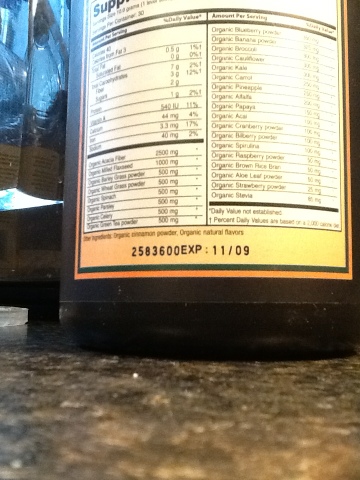
Here's what I use for my triple greens:


The reason I LOVE triple greens because it really helps me to get nutrients from food that I wouldn't get otherwise.


If your wondering why probiotics are great for you, or just thinking maybe I need some help figuring out if I have enough "good" bacteria to help gut flora I recommend taking a look at this!

I have personally been having gut issues for many years without realizing it. I also have indoor and outdoor allergies, not extreme, but enough to make me uncomfortable. Probiotic have been ONE way I have had help in this area. 

Also you can replace almond milk with coconut milk or raw grass-fed cow's milk. This is typically what I would do since this really helps me with my allergies, but our local farm doesn't produce from January to Spring. What I love about our milk is that I can make my own yogurt out of it without having to purchase from the store, that way I'm guaranteed live active good bacteria :)

The best part about this smoothie is that I was stuffed full! I could barely finish it and it provided a great amount of energy for a run at the gym! 

Monday, July 16, 2012

raw milk and more


This was too good not to post! Check out why we switched to raw milk a little over a year ago HERE!

This article was written by the Weston A. Price Foundation


Milk: It Does a Body Good?

PDFPrintE-mail
Written by Lori Lipinski   
July 6 2003

It all depends on where it comes from, doesn't it?

The subject of milk sparks just about as much controversy as the subject of fats. Many alternative practitioners feel that it's not necessary for humans to consume cow's milk and link its consumption to health problems, such as ear infections, allergies, cancer and diabetes. On the other hand, the medical community has convinced us that if we don't drink enough milk our bones will disintegrate. And the American Dairy Association wants us to think we'll be cool like celebrities with milk mustaches if we drink lots of milk.
The purpose of this article is not to convince you to drink milk or not to drink milk. Instead, it addresses those who do--or would like to--drink milk and consume dairy products. If you fit into this category, then you need to know where your milk has come from and what it has been through.

Living Conditions

If I were to ask you to picture a cow, you would most likely see in your mind a cow grazing in an open pasture, like one you'd probably seen before on a small family farm. That's a lucky cow, compared to most of the cows bred for dairy production in this country. The majority of commercial dairy cows don't have the luxury of grazing on open fields. Instead they are kept in intense confinement, in individual stalls, on hard cement floors, hooked up to milking machines, forced to produce milk ten months out of the year, in an overcrowded building. This is how the average commercial dairy cow spends her short, miserable life--42 months on average, compared to 12-15 years for a cow on pasture. 

Environment

Not only is the unnatural building environment a problem for the cow, but it can be a huge problem for the people around it as well. The massive amount of waste produced on a factory farm is overwhelming and can have devastating effects on the surrounding environment. Over one-fifth of the country's dairy products are produced in the central valley of California where confinement operations create as much waste as a city of 21 million people! Much of that waste is forced unnaturally into the environment, polluting our lakes, rivers and streams. On the other hand, small farms are able to recycle manure back into the earth to enrich the soil.

Feed

A cow's natural diet consists mostly of grass, but since there isn't enough grass to go around on the factory farm, today's factory cow is fed a diet of mostly grain, and other things that they would not normally eat. The bulk of the feed consists of corn and soy, which receives 80 percent of all herbicides used in the US. When we think of pesticides we usually think of produce, but animal products can contain up to 14 times more pesticides than plants!1
Simply switching the cow's diet from grass to grain can cause many problems, but that's only the beginning. According to a recent article in US News & World Report, some 40 billion pounds a year of slaughterhouse wastes like blood, bone and viscera, as well as the remains of millions of euthanized cats and dogs passed along by veterinarians and animal shelters, are rendered annually into livestock feed.
Animal-feed manufacturers and farmers also have begun using or trying out dehydrated food garbage, fats emptied from restaurant fryers and grease traps, cement-kiln dust, even newspapers and cardboard that are derived from plant cellulose. Researchers in addition have experimented with cattle and hog manure, and human sewage sludge."2
When I first read this I thought there were probably only a handful of farmers crazy enough to feed dead cats and dogs and other animals parts to their vegetarian cows, but I was dead wrong! During the BSE scare, the FDA ordered a halt to feeding all slaughterhouse wastes to cattle and sheep in the US. At that time 75 percent of the nation's 90 million cattle had been eating feed containing slaughterhouse by-products!
Like humans, animals need nutrients to thrive and be healthy. Obviously the feed given to factory farmed cows is not intended to provide proper nourishment. Instead, farmers, or shall I say food manufacturers, are interested in stuffing whatever they can into the cows to bulk them up as quickly as possible. This can quickly lead to sick animals and heavy doses of drugs. Like pesticides, these drugs end up in the milk of the dairy animals, as do trans fats from bakery wastes, undigested proteins from soy and animal foods and aflatoxins from moldy grain. To make matters worse, levels of vitamin A and D drop off precipitously when cows are given any feed other than green growing grass.

Antibiotics

If you're like a growing number of people today, you would rather not take antibiotics when you get sick. You may even be proud of the fact that you haven't had to use them in years. However, if you drink commercial milk or eat commercially raised meats and poultry, you could be consuming antibiotics on a daily basis without even knowing it! Over 50 percent of all the antibiotics produced in this country are mixed directly into animal feed. Ideally, antibiotics should be used in farming only when necessary to treat infection. However, due to the sickly nature of factory farmed animals, they are fed a constant supply of antibiotics from birth until the time of slaughter.
Antibiotic resistance is a serious issue that has gotten a lot of press in recent years. Basically, bacteria are mutating and outsmarting the antibiotics, making them ineffective. (The same phenomenon is occurring on farms where bugs are mutating to withstand pesticide applications.) We criticize medical doctors for over-prescribing antibiotics, but that is only part of the problem. Not only are antibiotics overused in this country, but they are also over-consumed. People are unknowingly consuming more antibiotics than they are actually taking by choice. Due to the heavy doses of antibiotics used on factory farmed animals, your steaks, hamburgers, chicken, and hotdogs are all laced with antibiotics. Milk alone contains traces of up to 80 different antibiotics!3

Hormones

Back in 1930, the average dairy cow produced 12 pounds (about a gallon and a half) of milk per day. In 1988, the average was 39 pounds per day. This was accomplished by selective breeding to obtain dairy cows that produced a lot of pituitary hormones, thereby generating large amounts of milk. But the industry was not satisfied with this output. Today rBGH, a synthetic growth hormone, is used to get even more milk out of the dairy cows, bringing the average up to 50 pounds (over 6 gallons) of milk per day.
Typical Modern Dairy Cow
CAPTION: A typical modern dairy cow. Her udder is so full it almost drags on the ground and she must be milked three times per day. Note the unusual growth in front of her forelegs--a goiter or a tumor?

This sounds like a great thing for dairy farmers, right? However, when you mess with Mother Nature, you will suffer the consequences. FDA documents show that cows injected with rBGH are 79 percent more likely to contract mastitis.4 In 1991, a report on Monsanto's BGH test herd at the University of Vermont found the same kinds of problems identified by the FDA, plus an alarming number of dead and deformed calves born to cows treated with BGH.5 Other problems include reproductive difficulties, increased need for antibiotics, digestive problems, enlarged hocks and lesions, and foot problems.
According to the Humane Farming Association, The FDA admits that BGH injections increase sickness and drug use in dairy cows. Consumer's Union reports that because of increased udder infections, it is more likely that milk from treated cows will be of lower quality--containing more pus and bacteria--than milk from untreated cows."6

Pasteurization

Pasteurization is a process of heat treating milk to kill bacteria. Although Louis Pasteur developed this technique for preserving beer and wine, he was not responsible for applying it to milk. That was done at the end of the 1800s as a temporary solution until filthy urban dairies could find a way to produce cleaner milk. But instead of cleaning up milk production, dairies used pasteurization as a way to cover up dirty milk. As milk became more mass produced, pasteurization became necessary for large dairies to increase their profits. So the public then had to be convinced that pasteurized milk was safer than raw milk. Soon raw milk consumption was blamed for all sorts of diseases and outbreaks until the public was finally convinced that pasteurized milk was superior to milk in its natural state.
Today if you mention raw milk, many people gasp and utter ridiculous statements like, "You can die from drinking raw milk!" But the truth is that there are far more risks from drinking pasteurized milk than unpasteurized milk. Raw milk naturally contains healthy bacteria that inhibit the growth of undesirable and dangerous organisms. Without these friendly bacteria, pasteurized milk is more susceptible to contamination. Furthermore, modern equipment, such as milking machines, stainless steel tanks and refrigerated trucks, make it entirely possible to bring clean, raw milk to the market anywhere in the US.
Not only does pasteurization kill the friendly bacteria, it also greatly diminishes the nutrient content of the milk. Pasteurized milk has up to a 66 percent loss of vitamins A, D and E. Vitamin C loss usually exceeds 50 percent. Heat affects water soluble vitamins and can make them 38 percent to 80 percent less effective. Vitamins B6 and B12 are completely destroyed during pasteurization. Pasteurization also destroys beneficial enzymes, antibodies and hormones. Pasteurization destroys lipase (an enzyme that breaks down fat), which impairs fat metabolism and the ability to properly absorb fat soluble vitamins A and D. (The dairy industry is aware of the diminished vitamin D content in commercial milk, so they fortify it with a form of this vitamin.)
We have all been led to believe that milk is a wonderful source of calcium, when in fact, pasteurization makes calcium and other minerals less available. Complete destruction of phosphatase is one method of testing to see if milk has been adequately pasteurized. Phosphatase is essential for the absorption of calcium.

Ultrapasteurization

As the dairy industry has become more concentrated, many processing plants have switched to ultrapasteurization, which involves higher temperatures and longer treatment times. The industry says this is necessary because many microorganisms have become heat resistant and now survive ordinary pasteurization.
Another reason for ultrapasteurization is that it gives the milk a longer shelf life--up to four weeks. The grocers like this but many consumers complain of a burnt or dead taste. The milk is virtually sterile--is that what you want to drink?
Milk producers are not advertising the fact that they are ultrapasteurizing the milk--the word is written in very small letters and the milk is sold in the refrigerator section even though it can be kept unrefrigerated until opened. Horizon, the major organic brand, is ultrapasteurized, as are virtually all national brands.

Homogenization

Milk straight from the cow contains cream, which rises to the top. Homogenization is a process that breaks up the fat globules and evenly distributes them throughout the milk so that they do not rise. This process unnaturally increases the surface area of fat exposing it to air, in which oxidation occurs and increases the susceptibility to spoilage. Homogenization has been linked to heart disease and atherosclerosis.

Milk: To Drink or Not to Drink?

Considering how modern commercial milk is produced and processed, it's no wonder that millions of Americans are allergic to it. An allergic reaction to dairy can cause symptoms like diarrhea, vomiting (even projectile vomiting), stomach pain, cramping, gas, bloating, nausea, headaches, sinus and chest congestion, and a sore, or scratchy throat. Milk consumption has been linked to many other health conditions as well, such as asthma, atherosclerosis, diabetes, chronic infections (especially upper respiratory and ear infections), obesity, osteoporosis and cancer of the prostate, ovaries, breast and colon.
Once you understand how modern milk is produced and processed, it seems logical to just avoid it altogether. But Real Milk--full-fat, unprocessed milk from pasture-fed cows--contains vital nutrients like fat-soluble vitamins A and D, calcium, vitamin B6, B12, and CLA (conjugated linoleic acid, a fatty acid naturally occurring in grass-fed beef and milk that reduces body fat and protects against cancer). Real milk is a source of complete protein and is loaded with enzymes. Raw milk contains beneficial bacteria that protects against pathogens and contributes to a healthy flora in the intestines. Culturing milk greatly enhances its probiotic and enzyme content, making it a therapeutic food for our digestive system and overall health.
So the answer to the question is--go ahead and drink milk only if you can get unprocessed milk from pastured cows. In the meantime, here are a few steps that can help you make the transition to more natural dairy products.

STEP 1: Remove Commercial Milk from Your Diet

Normally I propose a step-by step process for making a dietary change, but considering where commercial milk has come from, and what it has been through, it is best to just remove it from the diet altogether. Instead use some of the better quality dairy products such as raw cheese, good quality whole yogurt, butter and cream that has not been ultrapasteurized. (You can use butter or cream mixed with water on breakfast porridge.) Check the Weston A. Price Foundation Shopping Guide for a listing of good quality dairy products sold in supermarkets and health food stores.

STEP 2: Find a Source of Real Milk in Your Area

In states like California, this is easy because raw milk is sold in health food stores. In other states you need to either purchase raw milk from a farm or through a cow-share program. The best place to start is by contacting your local chapter or visiting the realmilk.com website. Most people who cannot tolerate commercial milk do beautifully on Real Milk--milk that comes from pastured cows, that contains all the fat and that is unprocessed. It is an especially good food for growing children who need extra nutrients during their growing years.
REFERENCES
  1. Nutrition News and Views, Nov/Dec 1999, Vol 3, No.6, p. 2.
  2. The Next Bad Beef Scandal?" US News & World Report, September 1, 1997.
  3. Nutrition News and Views, Nov/Dec 1999, Vol 3, No.6, p 2.
  4. Mark Kastel, Down on the Farm: The Real BGH Story- Animal Health Problems, Financial Troubles," published by Rural Vermont, 1991.
  5. Andrew Christiansen, Recombinant Bovine Growth Hormone: Alarming Tests, Unfounded Approval: The Story Behind the Rush to Bring rBGH to Market," published by Rural Vermont, 1991.
  6. http://www.hfa.org/.
This article appeared in Wise Traditions in Food, Farming and the Healing Arts, the quarterly magazine of the Weston A. Price Foundation, Spring 2003.
About the Author
Lori Lipinski is a Certified Nutritional Consultant, lecturer and writer whose articles have been published and quoted in highly respected national and international health journals and books. Lori developed the "Making the Transition" series to help people transition toward a REAL food diet, one step at a time.

Friday, January 13, 2012

Struggling with weight

MY FIRST GUEST POST!!!!!
****************** DAVE POIRIER ****************
Who happens to also be my dad :^) Be inspired!!!

I'm writing this because my daughter (Crystal) suggested that I may be able to help others by gleaming from my experience of dealing with excess weight. I didn’t even realize how much of a weight problem I developed over the years. It was as if I was living in denial. I was just like the frog that boiled to death and didn’t even know it. Put a frog in water, and when the water temperature is increased, ever so slightly, the frog will eventually boil to death without a chirp.

Another thought that comes to mind is when I used to smoke. I would say, “I really like to smoke.” Then one day I realized, I didn’t like it when I first tried it. Funny, the first time I tried a smoke I coughed and hacked through the whole experience. Eventually I turned addict, and denial set in. Slow weight gain can act the same way. Eventually you’re eating your way to an unhealthy lifestyle, and potentially an early grave.

Truth is, I’ve always had a problem with weight and for awhile I kind of controlled it by smoking (curved my appetite). Smoking is a TERRIBLE habit, and it took all I had to give it up. But it's worth it! It was about ten years ago when I quit, and like so many others before me, I began packing on the weight. I gradually put on about 50 lb growing from 190 to 240. In my mid 40’s the doctor put me on blood pressure medication, and most recently was introduced to a C-Pap machine, a unit helping you breath at night. The real issue was keeping my wife up all night with loud snoring, also caused from large deposits of fatty tissue in my nasal and throat passages. Everything was weight related! It was time I woke up from the denial.
(Me, back in the day)
Like the frog or the confident smoker, I didn’t see myself as being THAT overweight. I was blind, looking in the mirror, still seeing myself as if I was in high school. Now that’s funny! Here’s a guy 50 lbs over-weight, approaching 50, and thinks he’s still all that hunk! Then my youngest began to struggle with excess weight. As the years went by, the problem continued to grow and I didn’t know what to do. The situation affects the family dynamics, long with my marriage, and we still struggle with the best approach with what to do. So, we pray……continually.

It was praying and asking on behalf of my daughter when God answered. "Son," He said, "how can you expect anything from your child that's not operating in your own life first?" That’s it! Soon after the Lord spoke this to me, my employer had enlisted Weight Watchers to help employees lose weight. I jumped at the opportunity!

BEFORE and AFTER: Going for a run w/Brandon
So, now I'm 40 lbs (soon to be 50) lighter, off the blood pressure meds, off the C-Pap machine, all after changing my diet! WW is teaching me healthy ways to eat and how to listen to my body's hunger signs. I'm no longer addicted to food. They promote a lower fat, low carbohydrate intake while increasing protein and fiber. Regular exercise is also important (1/2 hour of exercise a day). I didn’t do that right away. So if your new to it, it's ok. I started very gradual, running further and further every week. And now I'm running 6 miles consistently! I never thought I'd be doing that at 50! If I can do it, you can do it too!

If you're struggling with getting healthy I HIGHLY encourage you to begin changing your diet and eating whole foods that are natural and nutrition-dense. This is what your body needs.

WW also introduced me to a varied number of supplements that I found beneficial and take on a regular basis:
  1. Psyllium husk – (2) table spoons every morning – See http://www.herbwisdom.com/herb-psyllium-husk.html , or read about it on Dr. OZ.
  2. Chia seeds – Great fiber super supplement, put in all kinds of food, reduces points for yogurt from (2) to (1) point because of the extra fiber. See: http://www.doctoroz.com/blog/lindsey-duncan-nd-cn/chia-ancient-super-secret
  3. Astaxanthin (10 gm) – (1) a day. Great antioxidant.


2012 brings in a new era at the Poirier household. My wife has embraced most of the new changes and has 110% supported the healthy lifestyle approach (it works best when everyone’s in the same boat). Our general practitioner has given my youngest approval to join WW this year and we find that the new insurance will cover some of the cost. So, here's to a year surrounded by God’s favor (2 Peter 3-11)!! Be blessed!

Monday, June 27, 2011

day 1

Hey Everyone. So I figured I'd share on something that my husband and I are recently starting. In fact, it starts today. So this marks day 1. Brandon recently really felt like the Lord was calling him to fast for a elongated period of time and wasn't sure what the fast may look like. But we both wanted to seek God pertaining to strategy.....a God-given blue print for the city of Rochester. Vision is a wonderful and powerful thing, but where's the steps to put it in action? And when we try to do things in our own way, our own time, most times the plan fails. So we're asking God for HIS strategy.

It then dawned on us as we were sharing about how sick the food industry makes us feel. That it is as if they have set people up to fail. And as the words came from my mouth...."is it even possible to eat a completely unprocessed diet?" and it hit us both. That's what our fast was suppose to be. No processed foods, no not one. The hard part about it all is even some "organic" foods are still processed so this changes things for us a lot. No cereals, no pasteurized dairy or juices, nothing prepared by someone else's hands, just simply foods....back to the basics of basics. I'll be honest I don't know if i can do it. But I'm asking God for grace and creativity. I'm VERY pregnant right now, but I'll be needing to make my own bread, prepare my own dairy (yogurt, butter, cheese), and prepare all my meals from scratch with no aid of a processed food. It's a lot to think about, but I think thats the point of the fast.

I really feel as we eat food that has been undefiled and untouched by man, that it is a prophetic act of God revealing a plan, a strategy that is also undefiled, untouched by man....a heavenly blue-print.

Also there are some things happening today that I think are really timely to everything. My mother (in-law) is coming into town to help me. Lately I have been in a lot of pain from the baby and how low she is sitting. I've had severe sciatic never pinching causing numbing and pain in my back and legs, along with LOTS of pressure of my pelvic bone, which has been making things difficult for bending and going up and down stairs. I've been been going to the chiropractor with some relief, but only for a couple days. So she's come to help, so focusing on simple things (like what i should eat) should be more of a joyful process than strenuous one :-) I'm really excited to have the extra help. I'm just not able to do what I normally do at this point.

I'll be sharing any new recipes I try on here. This is all pretty new to me and I never really found a good enough reason to try this, so now that I have I'm super excited. I plan to try quite a few recipes as well from Covenant Health's website....they have lots of great recipes from simple raw foods that look delicious.

so here's to day 1!

Saturday, February 12, 2011

Curried Lentils and Vegetable Stew


I didn't know what to make for dinner last night and so I decided to throw something together with little things we had lying around. Well, the dish came out delicious so I thought I'd share. I've been anemic now the last three years of my life, mostly because I've been pregnant and/or nursing for that long and nutrients get sucked dry when my body is burning extra energy. So, if I want to stay away from taking an additional iron supplement, I have to purposely eat foods high in iron. But as a lot of you know, I'm not a huge meat eater and I won't buy it unless its grass fed, free grazing, without antibiotics or hormones. Well, lentils is a great option for a an alternative source of protein and iron:-)

Here's a list of my ingredients:
6 cups of water
5 organic potatoes (cube them)
1.5 cups of organic green lentils (you can use any)
3 organic carrots (chopped)
1 large cooking onion
2 tablespoons of curry (yum)
1 tsp. of garlic powder
tablespoon of chopped garlic (yes...I used both)
salt to taste
2 tsp. of ginger powder
(add more ginger is you are nauseated from pregnancy...it helps everything settle nicely)

I sauteed the onions, carrots and chopped garlic separately over canola oil (could also use olive oil on low heat) on medium heat (I added a little salt and curry powder to it as well).

Everything else I threw in the crock pot to simmer all day. Once the other ingredients are cooked you can add them too. I had mine on for about 4 hours on high and then reduced the crock pot for one more hour on low. It tasted wonderful.....we topped it with parmesan cheese right before eating. You could also put over brown rice if you choose. And what's great is you can make it your own way by just substituting whatever you want by what you have in your house. (add a cup of water if stew becomes to thick.)

Lentils and brown rice have a very low glycemic index and the balance of the legume and grain provides a complete protein for vegetarians and flexitarians alike. Non-vegetarians should try this hearty dish as a meat replacement for dinner. The high fiber in the legumes and veggies are also excellent for digestive and heart health by aiding in lowering cholesterol. They are a source of folate, a necessary nutrient for pregnancy and women.

I was thinking....if not a main course...I may try serving this up next time with some lamb...

Hope you enjoy! We should did ;^D

Popular Posts